From the self, to the infinite.
Three bodies. Five koshas. One connected life.
An inquiry into the body, the mind and the awareness beyond them.
Duality
Creator/God (PURUSH) and Creation/the Universe (PRAKRITI). The Creator and the Creation by themselves stay still, with no action. The two together lead to action, resulting in movement in the Creation. This is the principle of duality.
Three bodies. Five sheaths.
Each individual has three bodies: Physical (Sthool), Subtle (Sookshma) and Causal (Kaaran).
Annamaya
The physical body, without life.
Pranamaya
The living body.
Manomaya
Mind and senses make the living body operational.
Vigyanmaya
Intellectual decision-making and discernment guide the mind.
Anandamaya
Brain memory can be in bliss with divine knowledge, and in depression with uncontrolled desires.

Body
Begin with the home you live in.
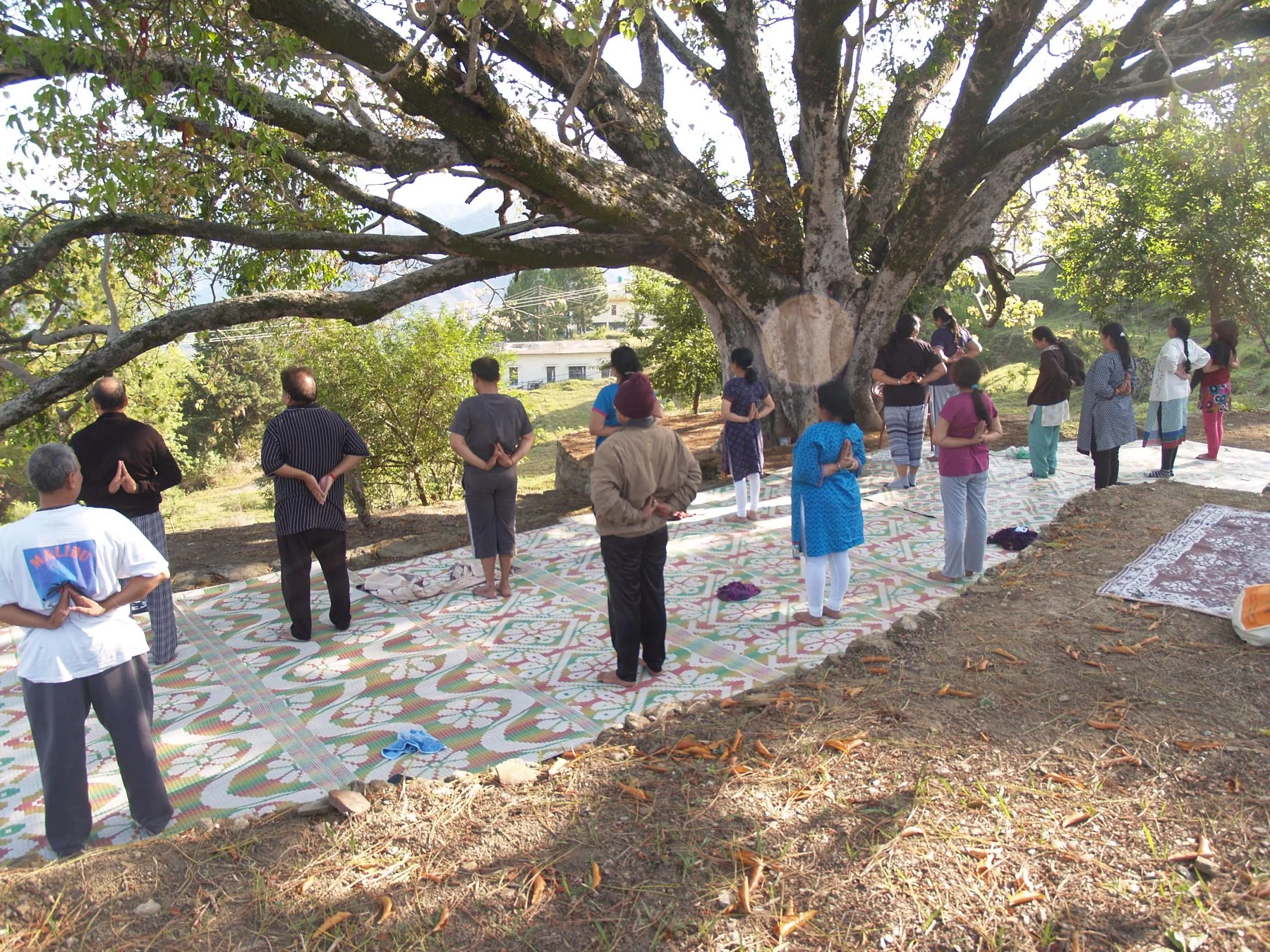
Your body is the foundation of experience. Through mindful movement, subtle exercises and conscious breathing, we attend to the physical body and the vital energy that sustains it. Ayurved adds a thoughtful approach to daily rhythm and balance.
Movement · Sookshma Vyayaam · Breath · Ayurved
Mind
Make room for clarity.
Thoughts, emotions, intellect and memory shape how we meet the world. Observing the mind with curiosity can open space between experience and response. Yog and focused awareness support a more conscious relationship with daily stress.
Awareness · Thoughts · Intellect · Memory
Soul
Return to your inner stillness.
Beyond the activity of body and mind lies the inner self. Meditation and quiet reflection invite you to explore a sense of peace, purpose and connection. Spirituality is approached as an inquiry, with openness and without promises of outcomes.
Meditation · Inner self · Purpose · Stillness
Universe
You are part of the whole.
Our journey expands outward to nature, other people and the wider universe. Universal human values transcend religion. A sense of shared belonging connects personal well-being with compassion, community and service.
Nature · Shared humanity · Consciousness · Service
Eight Fundamental Principles of Vedic Wisdom for Integrative Health and Wellness
You are not the body but the owner of the body.
Read more
The body is your first and foremost companion, exclusively at your service 24x7, and provides external connectivity, mobility and action. Neither can work without the other.
Ayurved is the science of healthy living, and supports recovery when illness arises.
Read more
Key words: Dinacharya (daily routine), Ritucharya (seasonal routine), Pragya Aparadh (going against nature's laws); the Dhatus that constitute the body (nutrition, blood, flesh, fat, bones, bone marrow and male/female energies); the Doshas (Kapha, Pitta and Vata; an imbalance between the three energies leads to illness); and efficient disposal of Mala (waste generated by the body's metabolic activity).
Nature's laws come first.
Read more
The body is made of the five basic elements: Space, Air, Fire, Water and Earth, and works according to nature's laws: early to rise, early to bed, fixed meal times, sound sleep, a helpful attitude towards the needy, weak and suffering, and the spirit of live and let live.
Give the body exclusive attention for at least one hour every day
Read more
for its upkeep and efficient running. It runs on breath, prana and the mind's supervision and guidance. It should never be skipped.
Pranayam is the process of stilling the flow of prana to the body
Read more
so that it can be functionally stilled by seating it in a stable and comfortable posture, and the individual living in the body can connect exclusively with the Chitta and become a detached spectator.
Contemplation and meditation are the tools
Read more
for the individual to reflect on the Chittavrittis and experience the Soul's subtle participation in realizing the Nirodh (peaceful) state. Deeper knowledge (Swadhyaya) of Vedic wisdom is an essential aspect of this deeper meditation and not a mere short-term sense of calm.
Vedic sciences are universal.
Read more
They go beyond race, religion, gender or geography.
Ayurved looks after the body and Yog looks after the person living in the body.
Read more
Together they support body health, peace of mind and a purposeful, humane life for the good of all.
The five-module path.
A curriculum designed by Chandra Mohan Bhandari, connecting daily physical care with the exploration of the Self.
Sookshma Vyayaam
Subtle joint exercises with brisk abdominal breathing; supports circulation, flexibility, posture and digestion; about 10 hours over 7 days; open to all ages.
Marma Science and Asanas
107 marma points; gentle pressure to support the flow of prana.
Yogic Postures and Pranayama
About 20 asanas with pranayama, bandhas and mudras, integrating physical, subtle and causal bodies.
Pranayama and Meditation
Breath is physical, prana is subtle; the focus is prana, not just breath.
Meditation and Spirituality as Evolved Sciences
For recognizing the clear distinction between the Ego, the 'I', and the pure Self through regular Swadhyaya (self-study) and daily practice. Each individual goes through different experiences for long, depending on the chosen path (action, devotion, knowledge) and the state of destiny from past Karmas (Prarabdha), but all start merging closer to each other with advancement towards Self-Realization.
Our programs are educational and aim to support the body's inbuilt immunity and overall wellbeing. They are not a substitute for professional medical advice, diagnosis or treatment. Our Integrative Health and Wellness approach focuses on improving breath, pranic energy flow, coordination between senses, mind and intellect, and an overall confidence in Self-Esteem. Many participants in our residential Retreats report feeling significantly better, and the practices are intended to complement, not replace, medical care. Please consult a doctor for any medical condition.
Attention turned inward.
सर्वद्वाराणि संयम्य मनो हृदि निरुध्य च ।
मूर्ध्न्याधायात्मनः प्राणमास्थितो योगधारणाम् ॥
ओमित्येकाक्षरं ब्रह्म व्याहरन्मामनुस्मरन् ।
यः प्रयाति त्यजन्देहं स याति परमां गतिम् ॥
Restraining the gates of the senses, holding the mind in the heart, directing prana to the head and established in yogic concentration, one who departs the body uttering Om—the one syllable of Brahman—and remembering the Divine reaches the supreme goal. These verses are offered as spiritual teaching, not as instructions for unsupervised breath practices.
Where does your journey begin?
A moment of reflection can reveal your next small step.
Take the Wellness Check